

Power for the essentials when the grid goes down.
Solar · Battery Storage · Generator Integration
Ground-mounted solar, battery storage, and optional generator integration designed around verified essential loads for rural homes and properties across Bushland, Amarillo, and the Texas Panhandle.
Essential-load systems — not normal whole-home operation. Final capability depends on verified loads, equipment, and site conditions.
Why layered backup matters.
Every power source has a limitation. Solar stops at sundown. Batteries hold a finite amount of usable energy. Generators need fuel and maintenance. The grid is dependable most of the time, and then occasionally it isn't. A layered system doesn't remove those limits — it arranges them so one failing doesn't leave you with nothing.
Solar
On-property daytime generation, and the opportunity to replenish stored energy when sunlight and system conditions permit.
Battery
Stored energy for selected loads when utility power is unavailable. Capacity is finite and is consumed at the rate your loads draw it.
Generator
Optional support for longer outages, poor solar conditions, or heavier verified demand. Requires fuel, maintenance, safe placement, and proper integration.
What the system is intended to support.
These are the loads a rural essential-load system is usually designed around. Which ones your system actually carries is decided during the load review — not on this page.
Your final load plan controls the design. Well pumps, motors, HVAC equipment, and other high-demand loads require specific technical review before they are included.
What this service is — and is not.
Designed for
- Essential-load resilience during outages
- Rural properties with suitable ground-mount access
- Owners who want more than a fuel-only backup plan
- Expandable planning, where compatible equipment and design permit
- Customer education and a documented handoff
Not automatically designed for
- Normal whole-home consumption
- Central air conditioning or electric heat
- Every well pump or motor
- Unlimited runtime
- Zero-maintenance ownership
- Roof installation at launch
Three starting points for the conversation.
These describe the problem each level is meant to solve — not a fixed product, specification, or price.
Essential Bridge
For a narrowly defined load plan and shorter outages — keeping cold storage, lights, and communications going through a limited interruption. Intentionally limited storage and the smallest qualified load list.
Essential Backup
The main rural configuration, with more storage and more solar recovery capability for multi-day weather events and repeat outages. Generator integration can be planned in.
Extended / Hybrid
Expanded storage, solar recovery, output, or generator integration for properties with larger verified demand — shop circuits, multiple wells, or livestock and agricultural equipment.
Every property is different. Final equipment, output, battery capacity, solar production, runtime, well-pump compatibility, installation scope, and price are established only after the property’s loads and site conditions are reviewed.
You will know what is included before any work begins.
Initial assessment
What you need to keep running, your outage history, where the property is, and the planning range you have in mind.
Load and site review
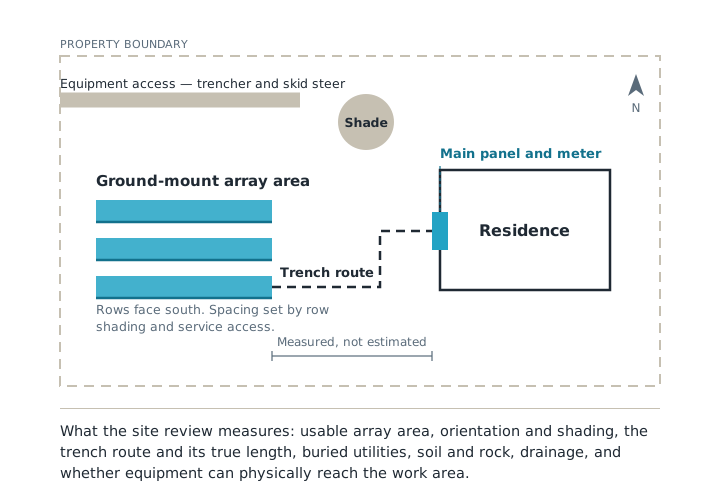
Appliances, well-pump data, electrical panels, any existing generator, available ground-mount area, equipment access, trench route, and shading.
System definition
Qualified loads, proposed equipment, stated exclusions, expected operating strategy, site-specific scope, and a budgetary proposal.
Licensed review and installation
Electrical design and electrical work are performed through the licensed electrical contractor. K2 coordinates the overall project and the appropriate site and mechanical work.
Commissioning and handoff
Testing, operating instructions, load-management education, warranty documentation, and closeout records.
How equipment gets chosen.
This is not the cheapest collection of components that can be found online. Backup equipment is only worth what it is worth on the day you need it and the year you need it serviced.
K2 does not publish a fixed service life for these systems. The goal is to select equipment that can still be supported years from now, and to document the ownership path so you know what maintenance, monitoring, and replacement look like before you buy.
Questions we get asked first.
Will this power my entire house?
No. These systems are designed around a defined list of essential circuits, not normal whole-home operation. Central air conditioning, electric heat, electric water heating, electric ranges, and large shop equipment are not included unless they are specifically engineered and quoted.
Can it run my water well?
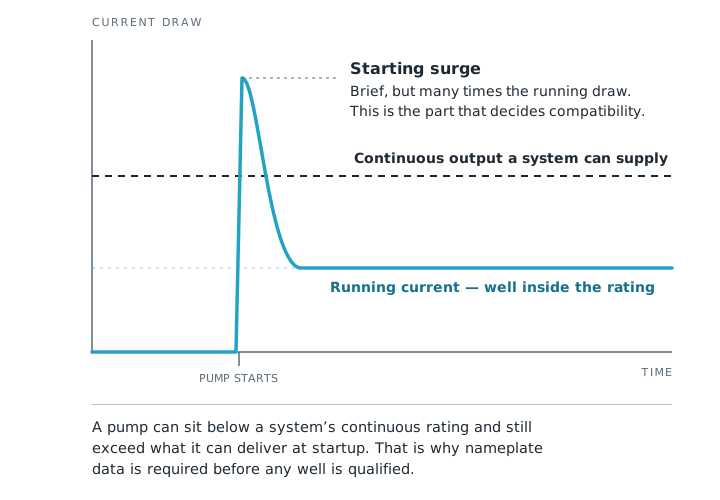
Sometimes, and only after the pump is qualified. We need the manufacturer and model, voltage, horsepower, running amperage, and the starting or locked-rotor characteristics, plus control-box or variable-speed-drive details. Nameplate photographs help.
Well pumps draw far more current starting than running, so a pump can be well within a system’s continuous rating and still be outside its motor-starting capability. That determination is made by the design team, not assumed.
How long will the batteries last during an outage?
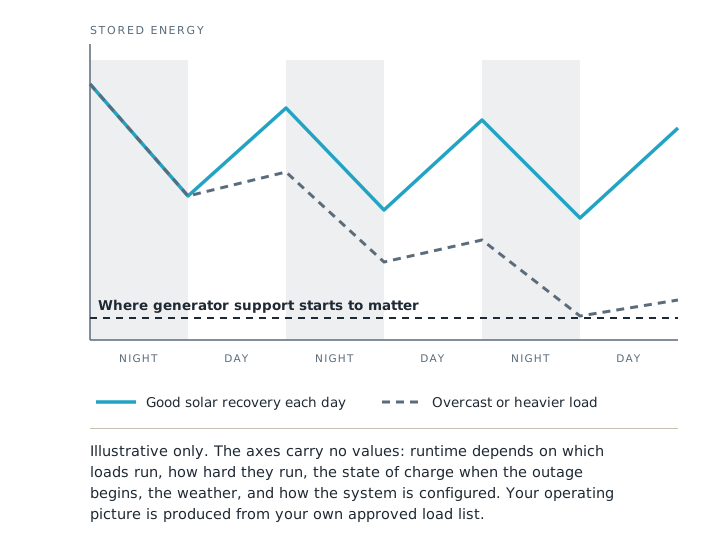
It depends on which loads are actually running, how hard they run, the state of charge when the outage begins, how much solar recovery the weather allows, and how the system is configured. We won’t publish an outage-duration number, because any number stated without your load plan would be guesswork.
What we will do is show you the expected operating picture for your specific approved load list before you commit.
Does solar work at night?
No. Panels produce during daylight. At night the battery supplies stored energy, and solar replenishes that storage the following day when sunlight and system conditions permit. Weather, shade, season, panel orientation, temperature, and system size all affect how much is recovered.
Why include a generator?
Redundancy. Several cloudy days in a row, a longer outage, or a heavier verified load can outpace what solar recovery and storage alone will support. A properly integrated generator can carry loads or help charge the battery during those stretches. It is optional, and it has its own limits: fuel supply, maintenance, safe placement, and compatible integration all have to be right.
Can you install panels on my roof?
Not at launch. This service is ground-mount only right now. Ground mounts are easier to service, easier to orient correctly, and avoid roof penetration and roof-condition questions on rural structures.
Do I need permits or utility approval outside city limits?
Possibly. Being outside city limits does not remove electrical licensing, safety, engineering, or utility requirements. Permit, inspection, and interconnection obligations vary by jurisdiction and by your electric provider, and they are evaluated for each property. Required electrical work is performed through a Texas-licensed electrical contractor.
Can I add batteries or panels later?
Often, but not automatically. Expansion depends on equipment compatibility, ratings, listings, the electrical design, and installation conditions.
One distinction worth knowing up front: adding battery capacity increases potential runtime, but it does not raise the inverter’s continuous output rating or its motor-starting ceiling. Adding panels increases potential solar recovery, but it also does not raise inverter output beyond the equipment’s ratings. If you expect to grow, say so during the assessment.
Are prices available online?
No, and that is deliberate. Trench distance, ground conditions, array location, panel and equipment availability, your load list, and the licensed electrical scope all move the number materially. A published price would either be wrong for your property or padded to cover the worst case.
What information is needed for an assessment?
Where the property is, how often you lose power and for how long, what you need to keep running, whether you are on a well, whether you already have a generator, and roughly where an array could go relative to your electrical equipment. If you are on a well, pump nameplate photographs move things along considerably.
Start with the loads that matter most.
Tell us what you need to keep operating and K2 will determine what is required for a responsible first-pass assessment. Submitting this form is not a quote, contract, performance guarantee, or commitment to purchase.
Not sure whether your well will run on it?
That is the first thing we check, and it is free to ask. Send the pump nameplate and we will tell you what is realistic before anyone talks about a system.